The Fastest Hiring Process Is Not Always the Best One
A company has been searching for a manager for 60 days.
Everyone is frustrated.
HR is under pressure.
The hiring manager wants more resumes.
Candidates are dropping out.
Eventually, the company decides the solution is obvious:
“Hire faster.”
That sounds correct.
But speed without structure often creates a second problem.
A candidate is hired quickly, performs poorly and leaves within six months.
The company has not reduced hiring time.
It has simply postponed the vacancy.
This is why learning How to Reduce Time to Hire requires a balance between speed and quality.
SHRM’s recruiting benchmark data has shown that time-to-fill for many roles still sits around a month and a half, while 2026 research continues to show that employers struggle to find the right full-time candidates.
The solution is not to remove important evaluation.
It is to remove unnecessary delay.
Slow Hiring Usually Starts Before Recruitment Begins
Many hiring delays are created before the job is ever advertised.
The role is not clearly defined.
HR believes one skill is essential.
The hiring manager believes another is essential.
The salary range does not match the market.
Everyone wants a “perfect candidate,” but nobody has agreed what perfect means.
Recruiters then spend two weeks sourcing the wrong people.
The first way to Reduce Time to Hire is therefore to improve the job brief.
Before sourcing begins, the company should know the three or four capabilities that are genuinely non-negotiable.
Everything else should be separated into preferences.
This single distinction can significantly widen the realistic candidate market.
Stop Searching for a Candidate Who Does Not Exist
Job descriptions often become wish lists.
A company wants ten years of experience, a specific qualification, five technologies, two industries, leadership exposure, a narrow salary range and immediate availability.
Very few people match everything.
Recruiters send fewer profiles.
Hiring managers reject them.
The process continues.
An effective Recruitment Process in India should ask which requirements predict success in the role rather than which requirements are easy to list.
This becomes particularly important for hybrid jobs where skills are evolving faster than traditional job descriptions.
Interview Stages Should Have Different Purposes
Another common cause of slow hiring is repetitive interviews.
HR asks about experience.
The hiring manager asks the same thing.
The functional head repeats it.
The CEO asks again.
Four rounds have happened, but the company has not learned four times as much.
Each stage should answer a different question.
An initial screen may validate motivation, compensation and basic fit.
A technical round should test capability.
A leadership or business round should examine judgement and organisational fit.
The final discussion should close remaining risks rather than restart the interview.
This is how Hiring Process Improvement reduces time without reducing assessment quality.
SHRM’s 2026 recruitment guidance also emphasises structured interviews and job-relevant assessments rather than unstructured evaluation.
Feedback Speed Matters More Than Interview Speed
A candidate may finish an interview in forty minutes.
Then nothing happens for seven days.
This is where companies lose strong candidates.
Hiring managers are busy.
Recruiters wait for feedback.
Another organisation moves faster.
The candidate accepts elsewhere.
SHRM has specifically highlighted slow handoffs and delayed hiring-manager feedback as common reasons recruitment processes lose momentum.
A practical solution is to create a fixed feedback SLA.
For example, interviewer feedback should be submitted the same day or within 24 hours.
The exact number matters less than consistency.
Build Talent Pipelines Before Roles Become Urgent
Reactive hiring creates unnecessary pressure.
An employee resigns.
The role becomes vacant.
Only then does sourcing begin.
SHRM’s 2026 analysis of reactive hiring notes that urgency can shift attention from the right fit to the best immediately available candidate, increasing the risk of mismatch and attrition.
Companies can reduce this problem by maintaining talent pipelines for recurring or business-critical positions.
If a manufacturer regularly hires maintenance engineers, it should not start from zero every time.
If a GCC continuously needs cloud professionals, candidate mapping should be ongoing.
Recruitment becomes faster when sourcing begins before the vacancy.
Use Technology to Remove Administration, Not Human Judgement
AI and recruitment technology can reduce screening and coordination time.
Applicant tracking systems can centralise data.
Automation can schedule interviews and manage communication.
AI can support initial matching.
But technology should not become the final decision-maker.
SHRM has warned in 2026 about overdependence on algorithmic hiring judgments and the risk of losing human context.
The goal should be:
automate administration,
not accountability.
Measure Quality of Hire Alongside Time-to-Hire
A company can proudly reduce average hiring time from 50 days to 25 days.
But what if more new employees leave during probation?
What if hiring managers are less satisfied?
What if performance declines?
Then the process is faster but worse.
SHRM’s 2026 research found that its highest-performing recruitment teams measure quality of hire at a significantly higher rate than average teams.
Companies should therefore track speed alongside measures such as:
- Hiring-manager satisfaction
- First-year retention
- Probation success
- Early performance
- Offer-to-join ratio
This creates a healthier recruitment dashboard.
Recruitment Agencies Can Reduce Sourcing Time
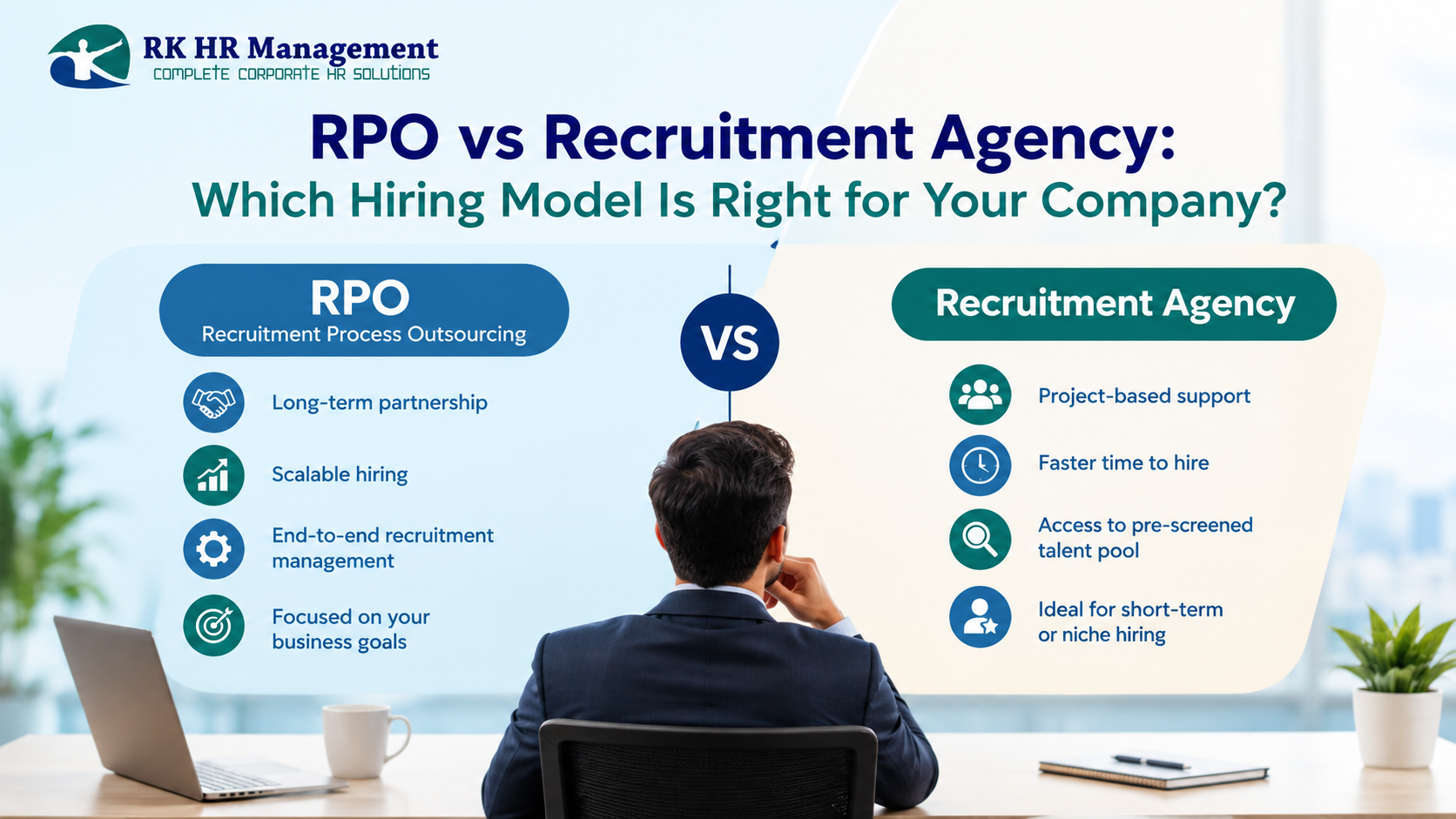
One reason companies use an external Recruitment Agency in India is access to existing candidate networks.
Instead of building every search from zero, recruiters can use databases, referrals, market mapping and passive sourcing.
For difficult positions, Head Hunting Services can help approach professionals who are not actively applying.
For senior positions, Executive Search & Selection provides a more targeted approach.
The recruitment model should match the position rather than using one method for every vacancy.
When RPO Can Improve Hiring Speed
Companies with sustained hiring volumes may discover that the internal recruitment team simply does not have enough capacity.
Recruiters spend time coordinating interviews, chasing feedback and managing administration instead of sourcing.
Recruitment Process Outsourcing can provide dedicated recruitment capacity and process ownership during periods of growth.
The objective is not merely to add recruiters.
It is to create a hiring system with clearer responsibilities.
The Best Way to Hire Faster Is to Remove Waiting
Most organisations do not need to make interviews dramatically shorter.
They need to remove the days between them.
Clarify the role before sourcing.
Agree the salary range.
Decide who has approval.
Give interview feedback quickly.
Avoid duplicate rounds.
Keep candidates informed.
Prepare offers before the final conversation.
These changes reduce Time to Hire in Recruitment without lowering standards.
Speed and quality are not opposites.
Poorly designed recruitment makes companies choose between them.
Well-designed recruitment improves both.
RK HR Management supports businesses with recruitment consultancy, executive search, headhunting and RPO depending on hiring volume and complexity.
The goal should never be to hire as fast as possible.
It should be to make the right decision without wasting time.