A Factory Can Be Built Faster Than Its Leadership Team
A manufacturer announces a new facility.
The land is finalised.
Machinery orders are placed.
Construction begins.
Management expects production to start on schedule.
Then recruitment begins late.
The company discovers that its Plant Head has a three-month notice period.
The Maintenance Head needs to relocate.
The Quality Manager accepts a counteroffer.
Automation talent is available, but compensation expectations are above the original budget.
The facility is nearly ready.
The team is not.
This is one of the realities behind Manufacturing Hiring in India in 2026.
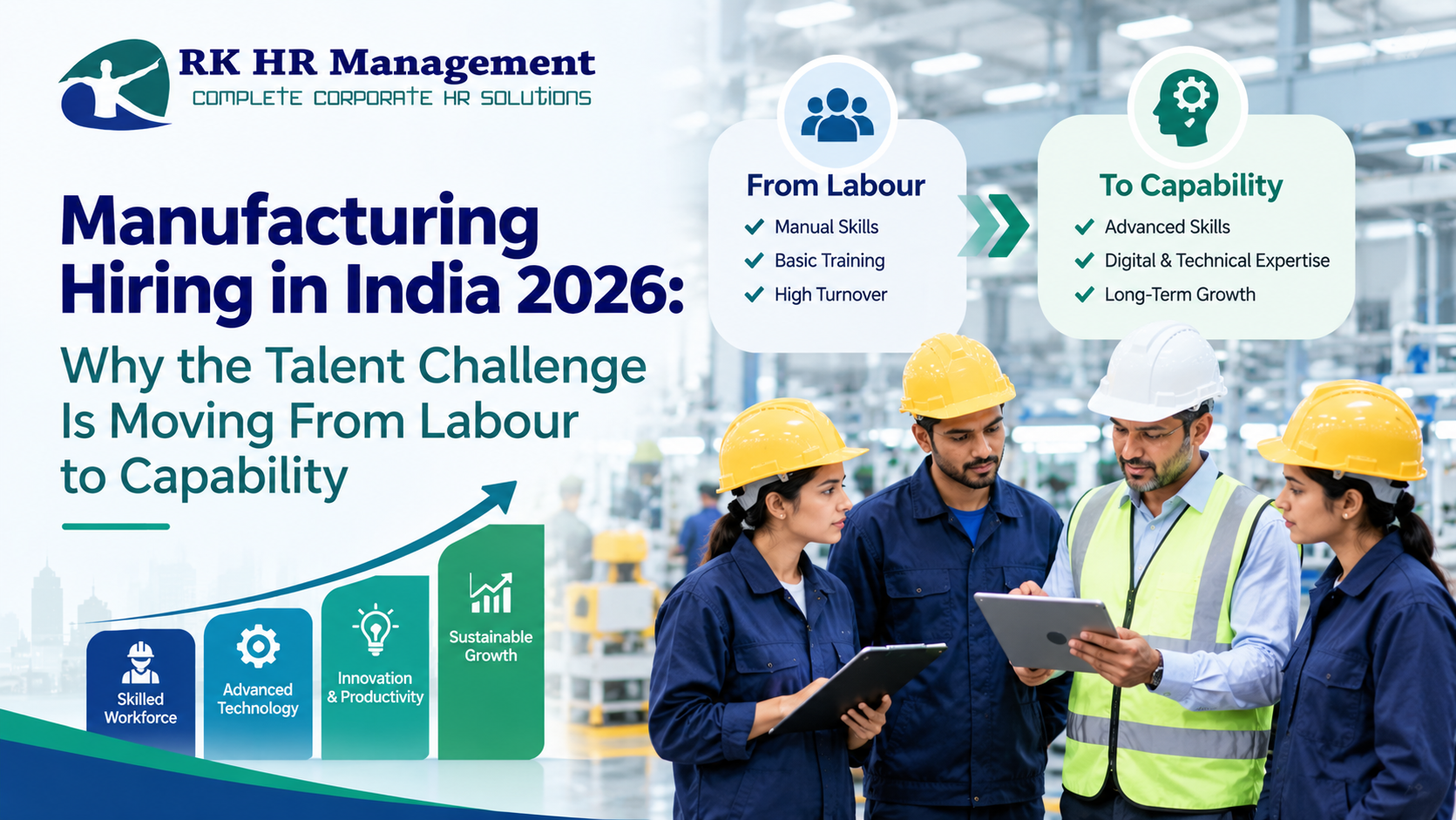
Modern manufacturing recruitment is no longer mainly about filling shop-floor vacancies. The bigger talent challenge is finding professionals capable of running increasingly automated, quality-driven and globally integrated plants.
Manufacturing Is Becoming More Technical
Factories are changing.
Automation, robotics, IoT, advanced quality systems, data analytics and energy-efficiency programmes are moving deeper into industrial operations.
As technology changes the plant, job profiles change with it.
A maintenance professional may now need exposure to PLCs, automation systems and predictive maintenance.
A production manager may be expected to analyse real-time plant data.
Quality leaders increasingly work with global customer standards.
Supply-chain professionals must manage international vendors and complex inventory requirements.
This means Manufacturing Recruitment in India increasingly sits at the intersection of traditional industrial experience and new technical capability.
The Plant Head Remains One of the Most Important Hires
Machinery does not create plant culture.
Leadership does.
The Plant Head influences production discipline, safety, quality, maintenance, workforce management and customer delivery.
For a new facility, the person may also need to build systems and recruit the next level of leadership.
This makes Plant Head Recruitment particularly important during a greenfield setup.
An executive who has managed a mature plant for ten years may be excellent at operational stability.
But a greenfield plant may need someone comfortable with ambiguity: vendor coordination, hiring teams, commissioning equipment, solving unexpected site problems and building processes from zero.
The title may be the same.
The leadership requirement is not.
RKHR’s Greenfield Plant Recruitment in India explains why workforce sequencing matters when an entirely new industrial operation is being established.
Manufacturing Companies Are Competing for the Same Technical Professionals
Different industries often recruit from the same underlying talent pool.
Automotive companies need maintenance engineers.
Chemical plants need them too.
Renewable-energy manufacturers need electrical and mechanical engineers.
Pharmaceutical plants require quality, utility and engineering professionals.
Electronics factories need production and automation expertise.
This creates competition across sectors rather than only within them.
A strong Manufacturing Recruitment Agency therefore needs to understand transferable skills.
If the recruiter searches only candidates from the exact same industry, the talent pool may be unnecessarily small.
Middle Management Is Where Many Plants Feel the Shortage
Senior executives receive significant attention.
Shop-floor hiring receives scale.
But manufacturing businesses often struggle most with the layer in between.
This includes:
- Production Managers
- Maintenance Managers
- Quality Managers
- EHS Managers
- Utility Managers
- Procurement Managers
- Supply Chain Managers
- Engineering Managers
- Shift and Section Heads
These professionals convert plant strategy into daily execution.
When this layer is weak, senior leaders end up solving operational problems that should never reach them.
That is why Production Manager Recruitment and experienced engineering hiring deserve the same workforce planning as senior leadership.
Manufacturing Recruitment Cannot Begin After the Machine Arrives
For a greenfield plant, hiring should follow the commissioning timeline.
Critical leadership should join early enough to participate in setup.
Technical managers should be available before trial production.
Operators and supervisors should be recruited and trained before commercial production begins.
The sequence matters.
Hiring too early increases cost.
Hiring too late delays operations.
RK HR Management supports organisations with recruitment across Executive Search & Selection, Head Hunting Services and broader manpower recruitment depending on the level and complexity of the position.
Location Still Determines Hiring Difficulty
A factory’s location significantly affects recruitment.
A plant near an established industrial cluster may have access to experienced production and engineering talent.
A remote site can require relocation hiring, accommodation support, transport facilities or stronger compensation.
This becomes particularly important for senior professionals with families.
Companies sometimes assume that a strong salary will solve location challenges.
It may not.
Schools, housing, spouse employment, commute and quality of life can influence whether a Plant Head or senior engineer accepts the role.
A realistic Plant Recruitment in India strategy therefore evaluates the complete candidate decision.
Industry 4.0 Is Creating Hybrid Roles
One of the most significant changes in Manufacturing Jobs in India is the emergence of roles that do not fit neatly into traditional departments.
A factory may need someone who understands operations and analytics.
Another may require a maintenance professional who can work with IoT systems.
Automation engineers increasingly need stronger process understanding.
Manufacturing IT teams need to understand operational technology as well as enterprise systems.
These hybrid roles are difficult because the ideal candidate may be rare.
Companies need to decide which skills are truly non-negotiable and which can be developed after hiring.
Trying to find a candidate who matches every possible requirement often extends time-to-hire without improving quality.
Campus Hiring Can Build the Next Layer
Not every manufacturing requirement should be solved through lateral recruitment.
Graduate engineers and diploma talent can be developed into future supervisors, production engineers and maintenance professionals.
Structured campus hiring creates a long-term pipeline while experienced recruitment focuses on positions where prior industry exposure is essential.
RKHR’s guide on How Recruitment Agencies Help Companies with University Hiring at Scale explains how companies can use university hiring as a structured workforce strategy rather than a one-time placement activity.
Manufacturing Hiring Is Becoming a Business-Critical Capability
Factories can invest heavily in equipment and still fail to achieve their productivity targets if the workforce is weak.
The right Plant Head can stabilise an entire operation.
A capable Maintenance Manager can reduce downtime.
A strong Quality Head can protect important customer relationships.
An experienced Production Manager can improve throughput without requiring new machinery.
This is why Manufacturing Hiring in India 2026 should be treated as part of industrial strategy rather than only an HR process.
RK HR Management supports companies with manufacturing, engineering, leadership and greenfield recruitment requirements across India.
The strongest manufacturing businesses of the next decade will not simply have better plants.
They will have better people running them.