Both Recruit People. That Does Not Make Them the Same.
A company needs five positions filled.
It gives the requirements to a recruitment agency.
Candidates are sourced, interviewed and hired.
Six months later, the same company announces rapid expansion and needs 150 people across several departments.
The internal HR team is overwhelmed.
Hiring managers are using different processes.
Candidate data is spread across spreadsheets and emails.
Recruitment agencies are working independently.
Nobody has one view of the complete hiring pipeline.
At this point, the company’s problem is no longer simply finding candidates.
It needs a recruitment system.
That is where the difference between RPO vs Recruitment Agency becomes important.
Both models support hiring.
But they solve different problems.
What Does a Recruitment Agency Do?
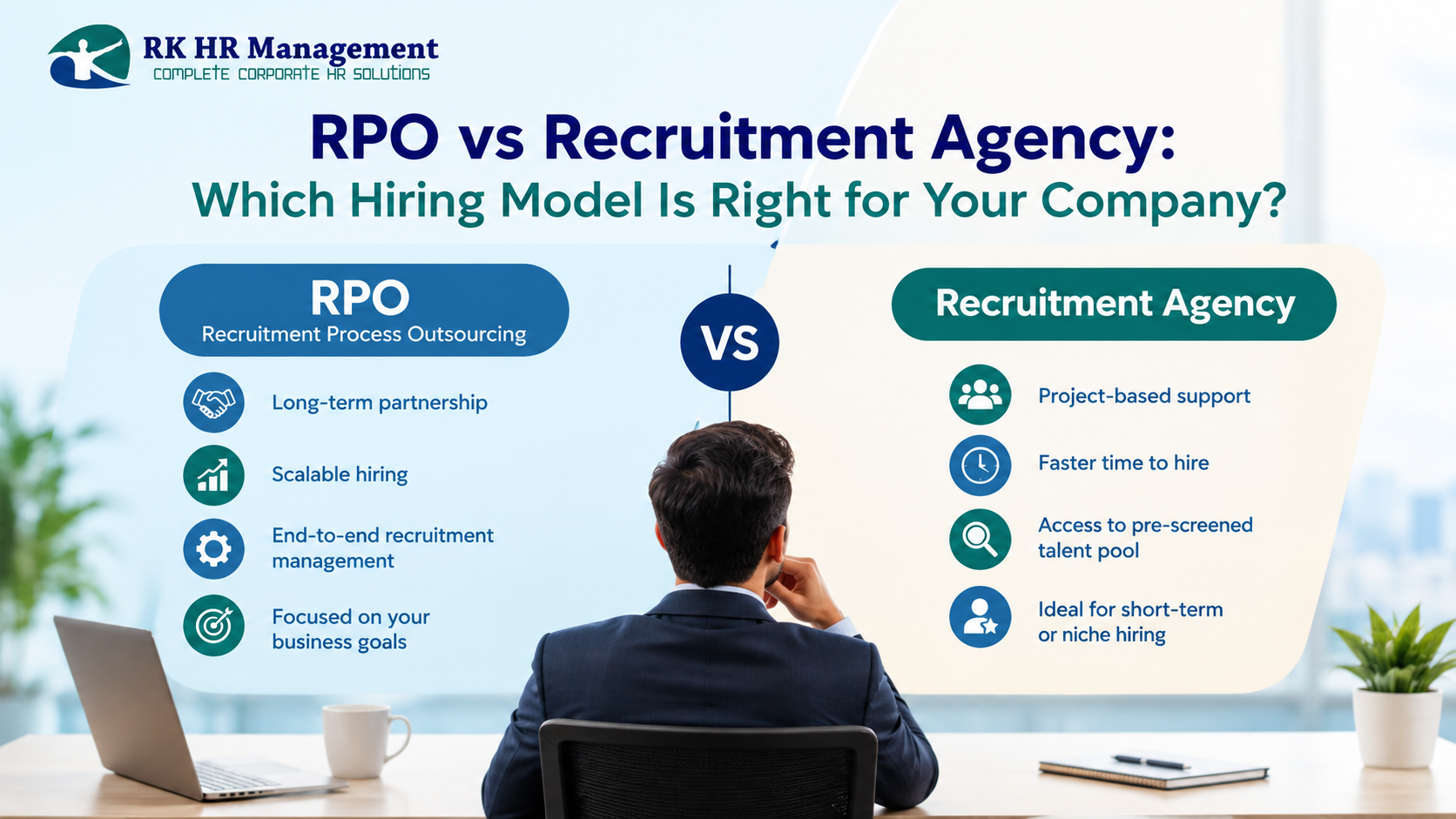
A traditional Recruitment Agency in India generally works vacancy by vacancy.
The employer provides one or more job requirements.
The consultancy identifies candidates, screens them and presents suitable profiles.
Payment is typically linked to successful placement, depending on the agreement.
This works well when an organisation needs external help for specific positions, specialist roles or occasional hiring.
For example, a manufacturer may need a Plant Head.
A FinTech firm may need a Compliance Manager.
A university may need a Dean.
A GCC may need an experienced Cybersecurity Director.
The company still owns the overall recruitment process.
The agency helps solve individual hiring requirements.
What Is Recruitment Process Outsourcing?
Recruitment Process Outsourcing, or RPO, is broader.
The external provider manages all or part of the organisation’s recruitment process rather than simply supplying candidates.
SHRM describes RPO as a model where a company outsources the management of its recruitment function, in whole or in part, to a specialist provider.
The RPO team may work almost like an extension of the employer’s internal talent-acquisition function.
Depending on the model, responsibilities can include workforce planning, sourcing, screening, interview coordination, candidate communication, reporting, recruitment technology and onboarding support.
RK HR Management’s Recruitment Process Outsourcing service is designed around this broader end-to-end approach.
The Difference Is Ownership
The easiest way to understand RPO vs Recruitment Agency is to look at ownership.
A recruitment agency helps fill vacancies.
An RPO provider helps operate the recruitment function.
Consider a company planning to hire 250 employees during the next twelve months.
Using multiple recruitment agencies may generate candidate pipelines.
But someone inside the company still needs to coordinate all those agencies, track performance, manage candidate experience, collect hiring-manager feedback and maintain recruitment data.
With RPO Recruitment, the provider can take responsibility for much of that operating layer.
The question therefore becomes:
Does the company need additional candidates?
Or does it need additional recruitment capability?
When a Recruitment Agency Is the Better Choice
RPO is not automatically better.
For many companies, a recruitment agency is exactly the right model.
An agency can make sense when hiring volumes are relatively low, requirements are occasional, the internal HR team can manage the process and the organisation mainly needs access to additional candidate networks.
Specialist search also remains valuable for niche roles.
An RPO provider running volume recruitment may still not be the right solution for one confidential CEO or Plant Head appointment.
That requirement may be better handled through Executive Search & Selection or Head Hunting Services.
When RPO Becomes More Useful
RPO Services in India become especially valuable when hiring turns into a continuous operational requirement.
This may happen during:
- Rapid company expansion
- New plant setup
- GCC launch
- Multi-location hiring
- High-volume annual recruitment
- Persistent specialist hiring
- Recruitment-team capacity shortages
In these situations, the employer needs repeatable processes rather than a series of independent vacancy closures.
An RPO model can provide dedicated recruiters, reporting and a more consistent recruitment workflow.
SHRM’s RPO directory highlights potential benefits such as standardised recruitment processes, broader talent access, reduced time-to-hire, candidate-experience improvements and lower hiring costs depending on the model.
RPO Can Be Full, Partial or Project-Based
Companies sometimes assume that choosing Recruitment Process Outsourcing in India means outsourcing every part of HR recruitment.
It does not.
An organisation may outsource the complete recruitment lifecycle.
Another may retain its internal team while the RPO partner handles specific functions or business units.
A third may use project RPO for a large plant setup or GCC launch and then transition hiring back to the internal team later.
The model should follow the business problem.
The Cost Comparison Is Not as Simple as Agency Fee vs RPO Fee
A traditional agency usually appears easy to calculate.
A placement happens.
A fee is paid.
RPO economics need to be evaluated differently.
The company should consider how many internal recruiters it would otherwise require, recruitment-technology costs, agency fees, hiring delays, management time and recruitment productivity.
For low-volume hiring, an agency may be more economical.
For sustained high-volume recruitment, an RPO structure can become more efficient.
There is no universal answer.
What About Quality?
Companies sometimes worry that outsourcing larger recruitment volumes will reduce hiring quality.
That depends on how the process is designed.
Speed should not replace assessment.
SHRM’s 2026 research notes that stronger recruitment teams are increasingly measuring quality of hire rather than focusing only on time-to-fill.
A strong RPO arrangement should therefore define both operational and quality metrics.
Hiring 100 people quickly is not success if 30 leave during the first year.
RPO vs Recruitment Agency: The Decision
Choose a Recruitment Agency when you need help filling specific positions and your internal HR team can manage the overall process.
Consider RPO when recruitment itself has become a sustained business operation that requires dedicated capacity, process ownership and reporting.
Use Executive Search when the requirement is senior, confidential or unusually specialised.
Large organisations may use all three models at the same time.
That is often the most practical approach.
RK HR Management provides recruitment consultancy, RPO, executive search and headhunting services, allowing the hiring model to change according to the requirement.
The best solution is not the most fashionable recruitment model.
It is the one that matches how your company actually hires.